번역 노트: 아래 내용은 arXiv 2602.12953v1의 Abstract 및 Section 1(Introduction)을 한국어로 직역에 가깝게 번역한 것입니다. 원문(English)은 탭에서 그대로 제공합니다.
¶ Abstract
인간-AI 협업은 AI 시스템이 복잡한 과제에서 점점 더 인간을 능가하는 한편, 인간은 오케스트레이션, 검증, 그리고 의사결정 감독 책임을 계속 지는 상황에서 커져가는 도전에 직면해 있다. 이 불균형을 해결하기 위해, 우리는 최근의 Model Context Protocol 설계를 바탕으로, AI 주도적이고 능동적인 워크플로 안에서 인간을 호출 가능한 도구로 노출하는 MCP 스타일 인터페이스 추상화인 Human Tool 을 소개한다. 여기서 “tool”은 인간의 권위나 책임을 축소한다는 의미가 아니라, 조정(coordination)을 위한 추상화를 뜻한다. LLM 기반 에이전트 아키텍처를 바탕으로, 우리는 인간의 기여를 역량(capabilities), 정보(information), 권한(authority)의 구조화된 도구 스키마로 모델링함으로써 Human Tool을 작동 가능하게 만든다. 이러한 스키마는 에이전트가 상대적 강점에 기반해 인간 입력을 동적으로 호출하고, 효율적이고 자연스러운 상호작용 프로토콜을 통해 이를 재통합하도록 한다. 우리는 의사결정 과제와 창의 과제 모두에서 통제된 실험을 통해 이 프레임워크를 검증하며, 기준선 시스템 대비 과제 성과 향상, 인간 작업부담 감소, 그리고 더 균형 잡힌 협업 동학을 보임을 확인한다. 마지막으로, MCP 스타일 인간 도구가 독특하게 인간적인 강점을 증폭시키면서도 강한 AI 리더십을 가능케 하는 방식을 강조하며, 인간 중심 AI 설계에 대한 함의를 논한다.
¶ 1 Introduction
AI 역량이 급속히 발전했음에도, 효과적인 인간-AI 협업은 여전히 요원하다. Vaccaro et al.의 최근 메타분석은 역설적인 패턴을 드러낸다. 인간이 개별적으로 AI보다 뛰어날 때는 협업이 성과를 개선하는 경향이 있는 반면, AI가 인간을 능가할 때는 협업이 종종 성과를 악화시킨다는 것이다 Vaccaro et al. (2024). 이 메타분석적 패턴은, AI 우위 조건에서의 성과 저하가 AI 역량 그 자체만이 아니라 협업이 일반적으로 조직되는 방식에서 기인할 수 있음을 시사한다. 많은 시스템에서, AI가 인간보다 더 잘 수행하거나 더 잘 확장될 수 있음에도, 인간이 오케스트레이션, 검증, 조정을 담당하는 책임을 계속 유지하는 경우가 많다.
선행연구는 이러한 인간 중심 오케스트레이션이 체계적인 병목을 도입할 수 있음을 보여준다. AI가 대규모로 복잡한 워크플로, 정보 통합, 규칙 실행을 처리할 수 있을 만큼 सक्षम할 때, 주의(attention), 기억(memory), 일관성(consistency), 대규모 조정(large-scale coordination)에 관한 인간의 한계가 두드러진다 Jarrahi et al. (2023). AI 우위 과제에서 인간에게 조정의 1차 책임을 부여하면 지연과 변동성을 초래하여 협업 품질을 잠재적으로 훼손할 수 있다. 이러한 메커니즘은 Vaccaro et al.이 보고한 AI 우위 협업에서의 성과 저하와 부합한다 Vaccaro et al. (2024), 그리고 인간 주도 조정을 기본 설계 선택으로 두는 것에 의문을 제기한다.
이 긴장은 HCI의 자율성 및 분업 연구에서 널리 논의되어 왔으며, 특히 혼합 주도(mixed-initiative) 상호작용에 관한 기초 연구가 대표적이다. 해당 연구는 맥락, 불확실성, 기대 효용에 따라 인간과 자동화 시스템 사이에서 통제와 주도권이 어떻게 동적으로 이동하는지를 정식화한다 Horvitz (1999). 이후 연구는 이 관점을 확장하여 혼합 주도 시스템에서의 신뢰, 공유된 이해, 통제 위치(locus of control)를 살펴보았고 Chiou et al. (2021), 자율성 수준(levels of autonomy) Beer and others (2014) 및 human-in-the-loop 감독(supervision) Sidaoui et al. (2022)을 다룬 연구도 이어졌다.
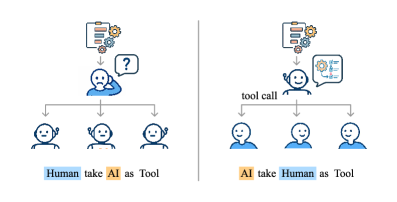
그림 1: 인간-AI 협업 패러다임의 대비: Human Tool 대 AI Tool. Human Tool 패러다임에서는, 인간이 워크플로 리더가 아니라 MCP 스타일의 호출 가능한 인터페이스로서 에이전트에 노출된다.
Figure 1: Contrasting paradigms of human-AI collaboration: Human Tool versus AI Tool. In the Human Tool paradigm, humans are exposed to the agent as MCP-style callable interfaces rather than workflow leaders.
우리는 이 인간 주도 설계 기본값이 현대 AI 역량과 점점 더 어긋나고 있다고 주장한다. AI가 과제의 상당 부분을 독립적으로 수행할 수 있을 때, 핵심 설계 질문은 인간이 어떻게 AI를 감독하는지에만 머물지 않고, AI가 언제 그리고 어떻게 인간의 전문성을 호출해야 하는지까지 포함해야 한다. 이는 협업을 인간 중심의 통제 문제에서 AI 중심의 조정 문제로 재구성하며, AI가 지속적 감독 대신 구조화된 도구형 호출을 통해 워크플로를 적극적으로 관리하고 인간 입력을 모집(recruit)하는 상황을 상정한다.
이를 위해, 우리는 AI가 워크플로 오케스트레이션의 소유권을 갖고 인간을 callable tools로 취급하는, AI 주도적이고 능동적인 협업 패러다임인 Human Tool을 제안한다. 이 관점은 자동화된 워크플로에 온디맨드 서비스로서 인간 기여자를 내장하는 방식으로 인간을 개념화했던 인간 계산(human computation) 및 크라우드 기반 시스템의 초기 연구와도 공명한다(예: Bigham et al. (2010)). 에이전트의 도구 사용 및 다중 구성 요소 플랫폼에 대한 최근 발전을 바탕으로 Schick et al. (2023), Human Tool은 현대 LLM 기반 오케스트레이션 아래에서 이 아이디어를 재구성하여, 인간을 MCP 스타일의 호출 가능한 인터페이스로 모델링하고, 인간의 판단, 창의성, 또는 맥락적 추론이 비교 우위를 제공할 때 선택적으로 호출될 수 있도록 한다.
Human Tool은 AI가 독립적으로 완수할 수 있는 과제(구조화된 인간 호출이 조정 병목을 다시 도입하지 않으면서도 견고성을 개선할 수 있는 경우)와, AI가 단독으로는 작동할 수 없는 영역(표적화된 인간 참여가 필수적인 경우) 모두에 적용된다. 이러한 의미에서, Human Tool은 AI 중심 워크플로를 원칙적인 인간-AI 협업으로 변환하기 위한 재사용 가능한 프레임워크를 제공한다.
우리는 Human Tool을 인간의 역량을 모델링하는 메커니즘, 인간 입력을 언제 호출할지 결정하는 메커니즘, 그리고 효율적인 AI-인간 커뮤니케이션을 가능케 하는 메커니즘을 통해 MCP 스타일 추상화로서 작동 가능하게 만든다. 또한 Vaccaro et al.이 논의한 조건에서 동기화된 두 가지 과제 유형에 걸쳐 32명의 참가자를 대상으로 한 통제 실험을 통해 이 프레임워크를 평가한다 Vaccaro et al. (2024): AI가 일반적으로 뛰어난 의사결정 및 최적화 과제, 그리고 인간 입력이 여전히 중요한 창의 과제. 필요에 따라 인간이 과제 분해를 주도하고 AI 도구를 호출하는 표준 패러다임을 따르는 AI Tool 기준선과 비교했을 때, Human Tool은 성과를 개선하고, AI 우위 조건에서 지각된 작업부담을 줄이며, 더 참여적인 협업 동학을 촉진한다.
¶ Abstract
Human-AI collaboration faces growing challenges as AI systems increasingly outperform humans on complex tasks, while humans remain responsible for orchestration, validation, and decision oversight. To address this imbalance, we introduce Human Tool , an MCP-style interface abstraction, building on recent Model Context Protocol designs, that exposes humans as callable tools within AI-led, proactive workflows. Here, “tool” denotes a coordination abstraction, not a reduction of human authority or responsibility. Building on LLM-based agent architectures, we operationalize Human Tool by modeling human contributions through structured tool schemas of capabilities, information, and authority. These schemas enable agents to dynamically invoke human input based on relative strengths and reintegrate it through efficient, natural interaction protocols. We validate the framework through controlled studies in both decision-making and creative tasks, demonstrating improved task performance, reduced human workload, and more balanced collaboration dynamics compared to baseline systems. Finally, we discuss implications for human-centered AI design, highlighting how MCP-style human tools enable strong AI leadership while amplifying uniquely human strengths.
¶ 1 Introduction
Despite rapid advances in AI capabilities, effective human-AI collaboration remains elusive. A recent meta-analysis by Vaccaro et al. reveals a counterintuitive pattern: when humans outperform AI individually, collaboration tends to improve outcomes, whereas when AI outperforms humans, collaboration often degrades performance Vaccaro et al. (2024). This meta-analytic pattern suggests that performance degradation in AI-advantaged settings may stem not from AI capability alone, but from how collaboration is commonly organized. In many systems, humans often retain responsibility for orchestration, validation, and coordination, even when AI can outperform them or scale better.
Prior work indicates that such human-centered orchestration can introduce systematic bottlenecks. Human limitations in attention, memory, consistency, and large-scale coordination become salient when AI is capable of handling complex workflows, information integration, and rule execution at scale Jarrahi et al. (2023). In AI-advantaged tasks, assigning humans primary responsibility for coordination can introduce latency and variability, potentially undermining collaboration quality. This mechanism aligns with the degradation observed in AI-advantaged collaborations reported by Vaccaro et al. Vaccaro et al. (2024), calling into question human-led coordination as a default design choice.
This tension has been widely discussed in HCI research on autonomy and division of labor, most notably in foundational work on mixed-initiative interaction, which formalizes how control and initiative dynamically shift between humans and automated systems based on context, uncertainty, and expected utility Horvitz (1999). Subsequent work has extended this perspective to examine trust, shared understanding, and locus of control in mixed-initiative systems Chiou et al. (2021), alongside research on levels of autonomy Beer and others (2014) and human-in-the-loop supervision Sidaoui et al. (2022).
Figure 1: Contrasting paradigms of human-AI collaboration: Human Tool versus AI Tool. In the Human Tool paradigm, humans are exposed to the agent as MCP-style callable interfaces rather than workflow leaders.
We argue that this human-led design default is increasingly misaligned with contemporary AI capabilities. When AI can independently perform substantial portions of a task, the central design question should extend beyond how humans supervise AI to also include when and how AI should invoke human expertise. This reframes collaboration from a human-centered control problem to an AI-centered coordination problem, where AI actively manages workflows and recruits human input through structured, tool-like calls rather than continuous oversight.
To this end, we propose Human Tool, an AI-led and proactive collaboration paradigm in which AI takes ownership of workflow orchestration and treats humans as callable tools. This perspective resonates with earlier work in human computation and crowd-powered systems, which conceptualized human contributors as on-demand services embedded within automated workflows (e.g., Bigham et al. (2010)). Building on recent advances in agent tool use and multi-component platforms Schick et al. (2023), Human Tool reframes this idea under modern LLM-based orchestration, modeling humans as MCP-style callable interfaces that can be selectively invoked when human judgment, creativity, or contextual reasoning provides comparative advantage.
Human Tool applies both to tasks AI could complete independently, where structured human invocation can improve robustness without reintroducing coordination bottlenecks, and to domains where AI cannot operate alone, where targeted human involvement is essential. In this sense, Human Tool provides a reusable framework for transforming AI-centric workflows into principled human-AI collaborations.
We operationalize Human Tool as an MCP-style abstraction through mechanisms for modeling human capabilities, deciding when to invoke human input, and enabling efficient AI-human communication. We evaluate this framework through controlled experiments with 32 participants across two task types motivated by conditions discussed in Vaccaro et al. Vaccaro et al. (2024): a decision and optimization task where AI typically excels, and a creative task where human input remains critical. Compared to an AI Tool baseline, which follows the standard paradigm where humans lead task decomposition and invoke AI tools as needed, Human Tool improves performance, reduces perceived workload in AI-advantaged settings, and fosters more engaged collaboration dynamics.